What Layers does
Layers reads the context behind your app and turns it into focused growth work: who to reach, what to test, which signal to read, and what to do next.
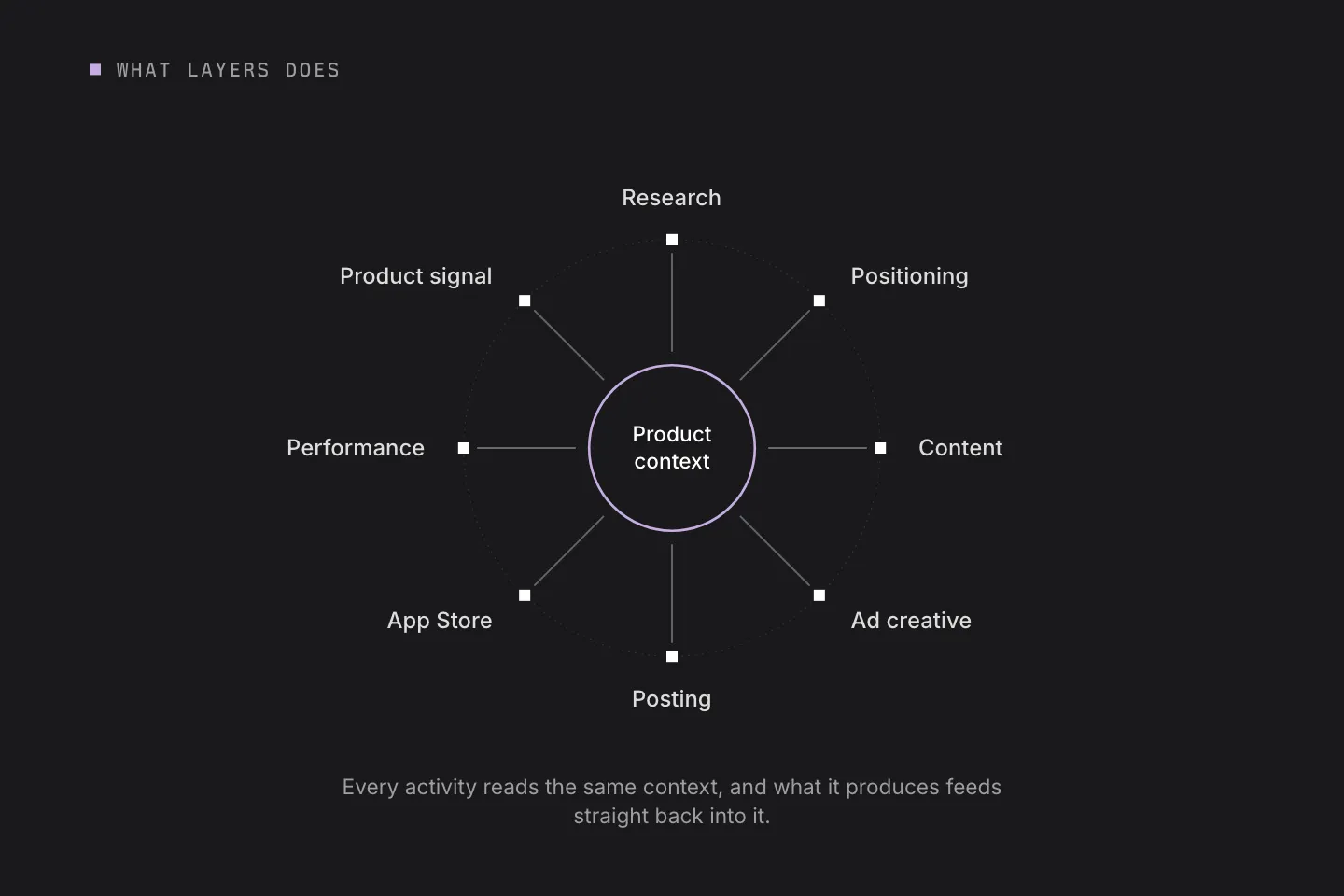
Layers helps app builders find focused ways to grow, run the work, and learn from what happens.
It starts by understanding the product.
Give Layers your website, App Store page, repo, or other product materials. Layers builds context around what the app does, who it could be useful for, the problems it solves, how it is positioned, and the growth surfaces worth exploring.
From there, the work follows a simple sequence.
Audience → message → experiment → signal → learning → next move
An example
Say you built a budgeting app.
Layers might identify freelancers as a promising audience, then focus on a specific problem such as irregular monthly income. From there it can develop messages around that problem, turn those messages into content or ads, help distribute them, and watch what happens.
That experiment produces signal. People watch, click, install, sign up, start a trial, or ignore it.
Layers uses those results to decide what deserves another test.
What the work can include
- researching audiences, competitors and trends
- developing positioning, hooks and messages
- generating content and ad creative
- posting and scheduling social content
- running and analyzing paid experiments
- improving App Store positioning and creative
- reading performance across connected channels
- measuring what users do after they arrive, via the Layers SDK
Each activity stays connected to the same product context and the results of previous work.
A strong hook can become the next ad. An organic post that brings in activated users can shape the next creator brief. Search demand can inform the store page. A campaign that produces clicks but weak users can be cut before more money goes into it.
The operating model
This is the basic operating model behind Layers.
Start with the app. Choose a useful growth hypothesis. Run something. Read the signal. Use what you learned to make the next move better.
Then do it again.