A growth loop, broken down
Six parts, one hiking app, and a worked example of how an audience becomes a hypothesis, an experiment, a signal, and a better next move.
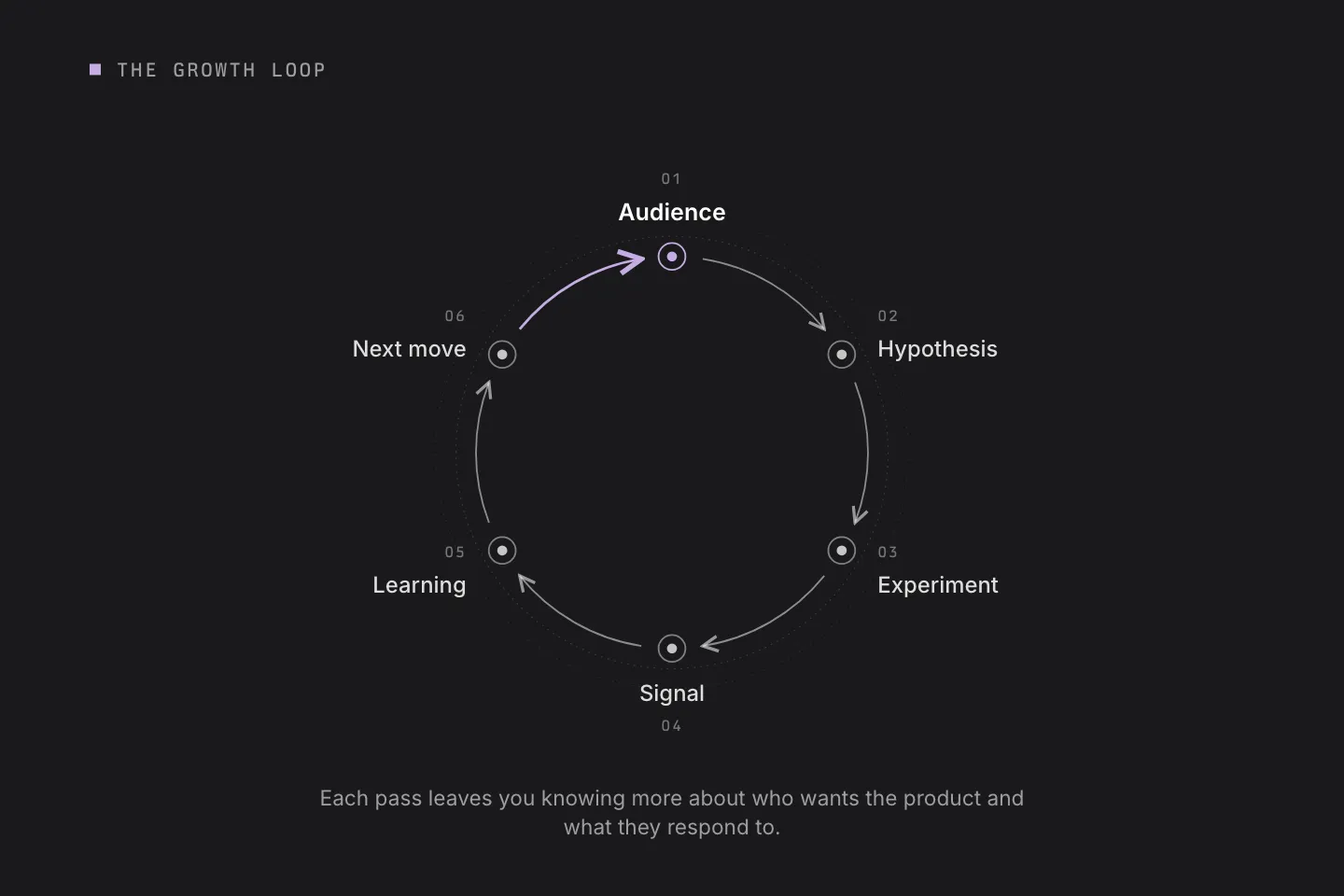
A useful growth loop has six parts.
Audience → hypothesis → experiment → signal → learning → next move
Here is a simple example.
Imagine you built a hiking app. It helps people find trails based on distance, difficulty, conditions and other filters.
1. Audience
Start narrower than “people who hike.”
For the first loop, you choose:
Dog owners looking for nearby hikes they can do with their dog.
That gives the rest of the experiment something concrete to work from.
2. Hypothesis
Now decide what you think this audience cares about.
Dog owners will respond to an easier way to find trails that are actually dog friendly.
You have something you can test.
3. Experiment
Turn the hypothesis into something people can see and respond to.
You might create several short videos around the same basic idea:
“Find a trail your dog can actually do.”
Show the app filtering for dog-friendly trails, leash rules, distance and difficulty.
Run the content on one channel and keep the audience and message consistent enough to learn something from the result.
4. Signal
Now watch what happens.
At the top of the funnel, you can look at things like watch time, saves, shares, profile visits and clicks.
Then follow the signal further: App Store visits, installs, account creation, activation, trials or purchases.
The Layers SDK can connect that activity back to the growth work that produced it.
5. Learning
Suppose the dog-focused content consistently gets saved, sends people to the store, and produces users who actually start using the app.
You have learned something useful about both the audience and the message.
You may also learn that another message gets more views but produces fewer activated users. That is useful signal too.
6. Next move
Use the result to choose the next experiment.
You could test another problem for the same audience, move the winning message into paid, build creator briefs around it, or carry the same language through to the App Store page.
Then measure again.
Why it compounds
That is a growth loop.
Each pass should leave you knowing a little more about who wants the product, what they respond to, and where to put the next unit of effort.